

The Storage Transformation from an Investment Strategist’s Perspective: How GenstorAIge’s CFO Is Driving an Industry Dialogue
|——“We are at the starting point of a productivity revolution. The storage demand brought by AI is not a short-lived pulse, but long-term, exponential growth.”——Zhong Liruo, Co-founder of GenstorAIge, Head of AI Strategic Expansion.
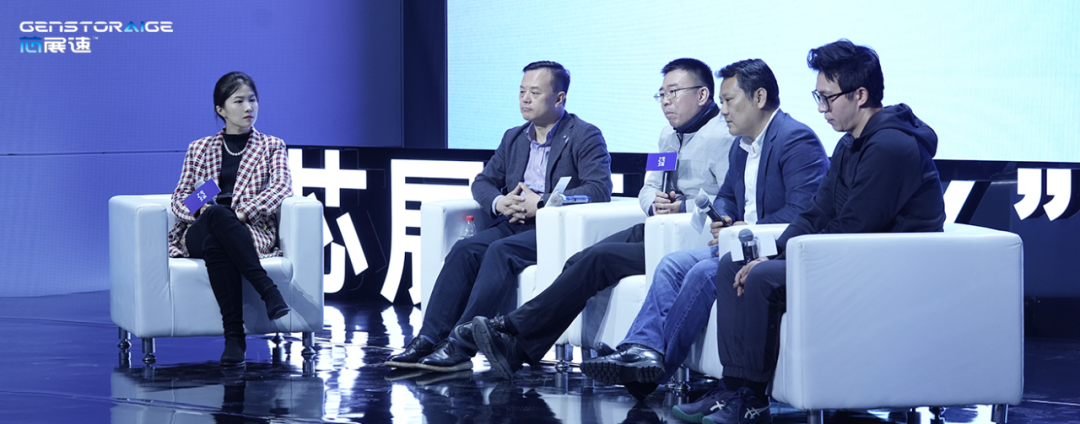
At the recent GenstorAIge “Zhen·6” launch event, an in-depth dialogue about the future of the storage industry unfolded on stage.
The initiator and key figure of this dialogue was Zhong Liruo, Co-founder, CFO, and Head of AI Strategic Expansion at GenstorAIge.
“In the semiconductor field, true value investing requires navigating cycles and identifying structural opportunities,” Zhong Liruo remarked at the forum's opening. “Today, we have gathered key figures from industry, capital, academia, and practice precisely to clarify challenges, build consensus, and jointly explore the path for storage to leap from a supporting role to a value creator.”
Industry Giant Perspective:
Yang Xu of Lenovo NetApp Discusses the “Data Dilemma” in AI Implementation
The forum's first topic directly addressed a core industry challenge. Moderated by Zhong Liruo, Yang Xu, CEO of Lenovo NetApp Technologies Co., Ltd.—a leader with nearly three decades of IT industry experience—shared frontline observations.
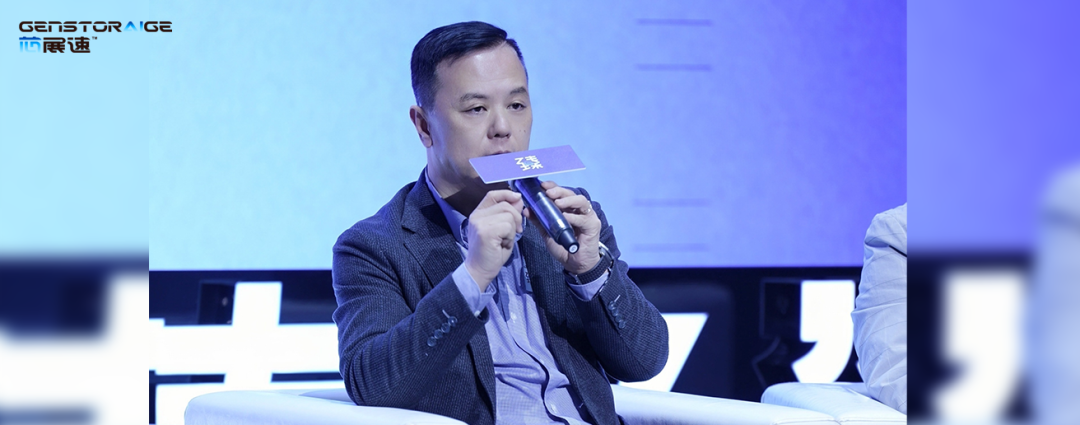
Yang Xu, CEO of Lenovo NetApp Technologies Co., Ltd.
“An overlooked fact is that up to 85% of AI projects remain stuck in the POC verification phase, and the failure rate of implemented projects is twice that of traditional IT projects.” Yang Xu pointedly noted that the crux of the problem often lies in the data preparation stage.
AI's requirements for data quality, real-time performance, and consistency far exceed those of traditional digitalization. Enterprise data is typically scattered across hybrid cloud environments and various departments, forming silos. He emphasized that this requires deep collaboration between system vendors like Lenovo NetApp and upstream innovators like GenstorAIge, helping customers maximize data value within limited investments through architectural innovation—a key to successful AI implementation.
Capital Helmsman's Insight:
Wang Lin of Walden International on the “Innovation No Man's Land” of Domestic Substitution
When the conversation turned to the industrial ecosystem and domestic substitution, the dialogue between Zhong Liruo and her former senior mentor, Walden International Managing Partner Wang Lin, was particularly thought-provoking. With a technical background from Samsung Semiconductor and having led investments in dozens of semiconductor companies, Wang Lin's perspective combines technical depth with capital market acumen.
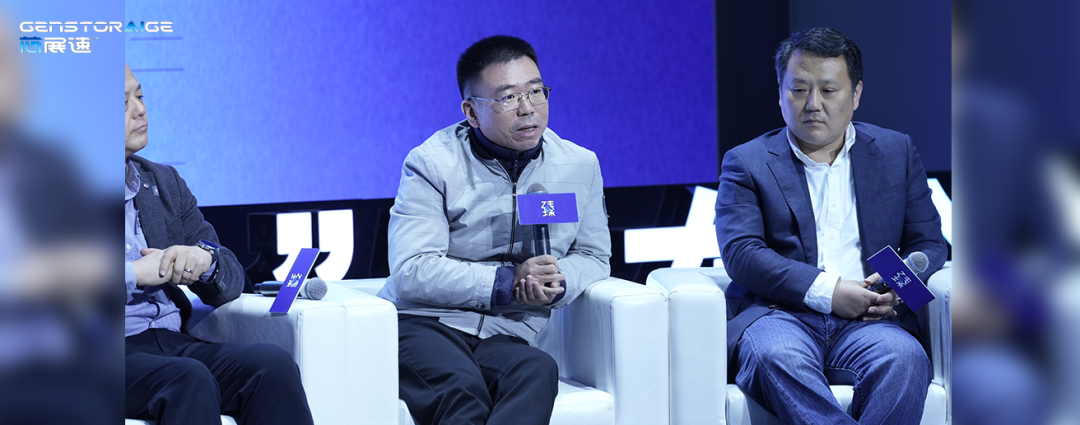
Wang Lin (Center), Managing Partner of Walden International
“Frankly speaking, before the Trump sanctions, many storage sub-sectors did not meet VCs' definition of ‘technological innovation’,” Wang Lin recalled. “But geopolitics has forced China's storage sector into an ‘innovation no man's land’.” He pointed out that Chinese companies are blazing a trail different from traditional giants by collaboratively developing entirely new architectures and processes with local equipment and material suppliers.
For AI-era storage startups like GenstorAIge, Wang Lin believes that industry connections, ecosystem influence, and customer trust are just as important as technological innovation. “What the GenstorAIge team demonstrates is precisely this rare market-driven technological innovation capability.”
Innovation Practitioner's Voice:
Shi Xin of Yanxin Micro Deconstructs the Future Form of “Processing-in-Memory”
As a representative of technological pioneers at the forum, Shi Xin, Chief Marketing Officer of Yanxin Micro, shared the latest practical insights from the processing-in-memory field. His career spans top companies like AMD, ARM, and Huawei, giving him dual insights into technology trends and commercial implementation.
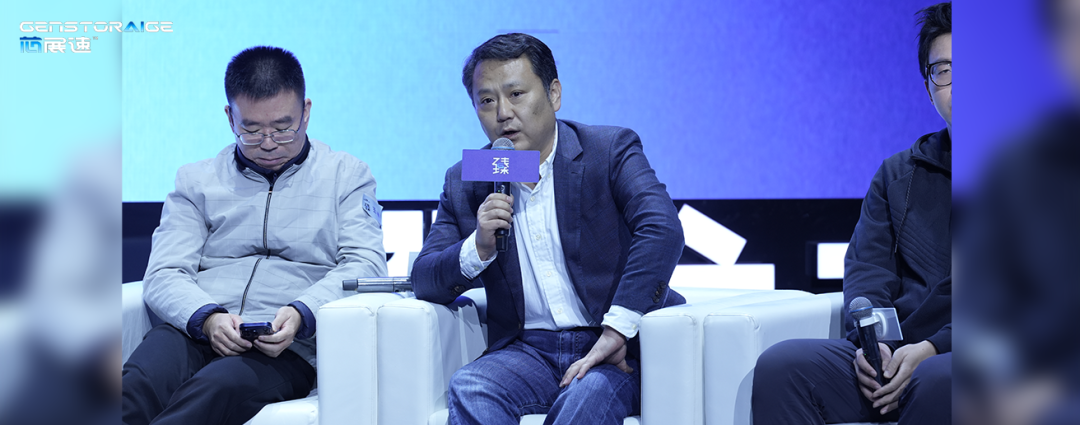
Shi Xin, Chief Marketing Officer of Yanxin Micro
“The industry is shifting from ‘compute-centric’ to ‘data-centric’.” Shi Xin used a vivid analogy, saying that powerful computing unable to efficiently access data is like “installing an airplane engine on a tractor.” He believes that processing-in-memory is a key direction for breaking the “memory wall” and achieving breakthroughs in system energy efficiency.
He predicted that future storage will exhibit two major trends: “scenario-based tiering” and “functional integration”—from cloud training to edge inference, different forms of storage products are needed; simultaneously, storage chips themselves will integrate intelligent processing units, shifting from passive storage to closer compute-data synergy.
Academic Authority's Insight:
Tao Yaoyu of Peking University Envisions the Ultimate Convergence of Storage and Computing
The finale featured Tao Yaoyu, a researcher at Peking University's Institute for Artificial Intelligence and School of Integrated Circuits, injecting cutting-edge academic insight into the forum. This young scholar, with a background from Stanford and the University of Michigan and experience as a Principal Scientist at Qualcomm, is dedicated to exploring AI-oriented software-hardware co-design.
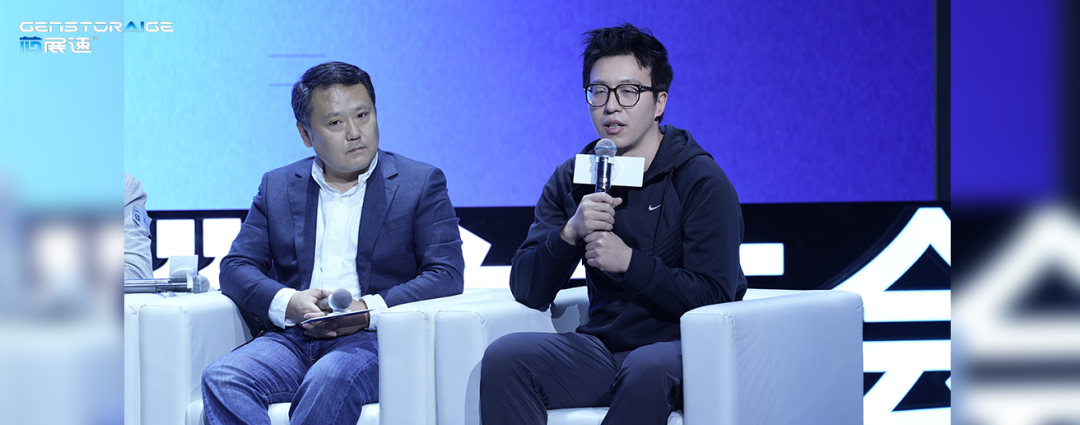
Tao Yaoyu, Researcher at Peking University's Institute for Artificial Intelligence and School of Integrated Circuits
He clearly categorized processing-in-memory technology into two levels: “near-memory computing” and “in-memory computing.” The former is more compatible with existing industry, while the latter is more disruptive. “We are researching how to use new memory devices to perform complex operations directly within the array, even solving differential equations,” Tao Yaoyu introduced.
He further pointed out that the rapid evolution of large model algorithms themselves (such as MoE and world models) is continuously generating new demands on the bandwidth and operation modes of the underlying storage system. The co-evolution of algorithms and hardware will determine the ultimate efficiency of future AI systems.
Consensus and Departure:
The Role Reshaping of Storage and GenstorAIge's Positioning
Under Zhong Liruo's guidance, the roundtable forum ultimately coalesced into a core consensus: In the intelligent era, storage is transforming from a cost center and backend supporter into a core creator determining AI efficiency and value.
This dialogue, gathering wisdom from industry, capital, technology, and academia, also reflects GenstorAIge's own development logic: adopting a strategy of “full-stack capabilities” (storage-connectivity-management) and “progressive deployment” (cloud-edge-device), building an open innovation ecosystem through deep connections with industry giants, capital forces, technology pioneers, and academic minds.
As Zhong Liruo stated in her summary: “This is a systemic race around the data foundation. Together with our ecosystem partners, we aspire not only to be participants in technological iteration but also to be definers of the new paradigm for future storage value.”
Official Website: www.gsaitech.com